Post 5 of the Dynamic Arrays in C series · Full source code on GitHub
The Ergonomics Problem
Post 4 left us with a working generic array. One struct, one push function, one get function, stores any fixed-size type. The void* engine works. But using it is miserable.
To push an integer, you can’t just write array_push(arr, 42). You have to create a variable, then pass its address: int x = 42; array_push(arr, &x);. Two lines for something that should be one expression. To read a value back, you get a void* that you must cast manually: int *val = (int *)array_get(arr, 0);. Every access requires a cast. Every cast is an opportunity to lie to the compiler, write double *val = (double *)array_get(arr, 0) on an int array, and the compiler won’t say a word. You’ll get garbage at runtime and spend an hour wondering why.
This isn’t a theoretical concern. In a real codebase with ten arrays of five different types, casting void* at every access point is a maintenance hazard. Someone will copy-paste a retrieval line, change the variable name but forget to change the cast, and introduce a silent corruption bug that only manifests under specific data patterns. Type erasure gave us flexibility; now it’s giving us paper cuts.
The question for this post is: can we get the convenience of typed access, ARRAY_PUSH(arr, int, 42) as a single expression, ARRAY_GET(arr, int, 0) returning an int* without a manual cast, while keeping the single void* implementation underneath?
The answer is yes, and the tool is the C preprocessor. Macros let us write code that generates code. Specifically, we’ll write macros that create a temporary variable of the right type (so the compiler checks the assignment), verify that sizeof(type) matches arr->element_size (catching mismatches at runtime), and delegate to the void* functions we already have. The user gets a type-safe API; the implementation remains generic.
This is not a novel pattern. Production C libraries use it everywhere. GLib’s g_array_append_val is a macro that wraps a void* function. The Linux kernel’s container_of is a macro that provides typed access to raw pointers. Sean Barrett’s stb_ds.h takes this even further with macros that synthesize entire type-specific APIs. The pattern is old, proven, and worth understanding because it’s the closest C gets to generics without code generation.
But macros have costs. They’re hard to debug, when something goes wrong, the error message points to the expanded code, not the macro call. They can have surprising behavior with side effects (what happens if the “value” argument is x++?). They don’t play well with IDE autocomplete or code analysis. And they add a layer of indirection that every reader of your code must mentally expand.
The tradeoff this post explores is macro complexity vs type safety. How much preprocessor machinery are you willing to add to prevent type errors? Where’s the line between a helpful wrapper and an unreadable mess? And what can macros catch at compile time versus what they can only detect at runtime?
Let’s build the wrapper layer.
The Macros: What They Do
We build five macros on top of the existing void* API. The internal functions, array_create, array_push, array_get, array_set, element_at, are unchanged from Post 4. Everything in this post lives above that layer.
The complete source, all macros, six demos, type mismatch detection, and the DOT generator, is available on GitHub.
ARRAY_CREATE: Hiding sizeof
The simplest wrapper, replaces array_create(sizeof(int), 8) with ARRAY_CREATE(int, 8):
| |
One line. The caller specifies the type name; the macro computes sizeof for them. No room to get it wrong, you can’t accidentally write ARRAY_CREATE(int, 8) and end up with sizeof(double). The type name is the source of truth.
ARRAY_PUSH: The Temporary Variable Trick
This is the central macro. It solves the “two-line push” problem:
| |
Three things happen inside this macro:
First, the do { ... } while(0) wrapper. This is the standard C idiom for making multi-statement macros behave like a single statement. Without it, if (cond) ARRAY_PUSH(arr, int, 42); would break, the if would guard only the first statement of the expansion, and the rest would execute unconditionally. The do/while(0) wraps everything into one compound statement that the semicolon terminates cleanly.
Second, the size check. sizeof(type) is evaluated at compile time, it’s a constant. arr->element_size is checked at runtime. If they don’t match, the macro prints a diagnostic (including the file and line via __FILE__ and __LINE__) and does not push anything. The array remains untouched. No corruption, no truncated bytes, no silent garbage.
Third, the temporary. type _push_tmp = (value); creates a local variable of the correct type and assigns the value to it. This is where the compiler does type checking, if value isn’t assignable to type, you get a compile error. Then &_push_tmp is passed to the void* array_push. The temporary lives on the stack for the duration of the do/while block, long enough for memcpy to copy its bytes into the array.
The #type syntax (stringification) converts the type name to a string literal for the error message: #int becomes "int", #double becomes "double".
ARRAY_GET: An Expression, Not a Statement
ARRAY_PUSH is a statement (it doesn’t return a value). ARRAY_GET must be an expression, it returns a typed pointer. This means we can’t use do/while(0):
| |
This uses two less common C operators. The ternary (? :) checks the size match first. If sizes differ, it takes the error branch. If they match, it casts the result of array_get to type* and returns it.
The comma operator in the error branch does two things in sequence: fprintf(stderr, ...) prints the diagnostic (evaluated for its side effect), then (type *)NULL is the actual value of the expression. The result is: print an error and return NULL, all in one expression.
Usage is clean:
| |
No manual cast. The type is specified once, in the macro call, and the returned pointer is already int*.
ARRAY_FOREACH: Iteration Without Casts
The foreach macro wraps a typed for-loop:
| |
The outer loop iterates _fe_i from 0 to arr->size. The inner loop is a trick: it declares var_name as a typed pointer, executes the body once (while var_name is non-NULL), then sets var_name to NULL to exit. This double-for pattern lets us declare a new variable in the loop header without relying on compiler-specific block scope extensions.
Usage reads almost like a for-each in a higher-level language:
| |
The Code
The complete file compiles with gcc -Wall -Wextra -std=c11 with zero warnings. It carries forward the void* core from Post 4 unchanged, adds the five macro wrappers, and includes six demonstrations that exercise every macro and show what happens when types mismatch.
The ASCII visualization adds a “macro layer” view, for each array state, it shows both the user-facing macro call and the internal void* operation it maps to, alongside the raw byte layout:
╔════════════════════════════════════════════════════════════════════════╗ ║ Arrayvia ARRAY_PUSH macro ║ ╠════════════════════════════════════════════════════════════════════════╣ ║ Macro API: ARRAY_CREATE(int, 8) ║ ║ Internal: void* (erased) element_size: 4 bytes ║ ║ size: 5 capacity: 8 reallocs: 1 ║ ╠════════════════════════════════════════════════════════════════════════╣ ║ API mapping (macro → internal): ║ ║ ARRAY_PUSH(arr, int, val) → { int tmp=val; array_push(arr,&tmp); } ║ ║ ARRAY_GET(arr, int, i) → (int*)array_get(arr, i) ║ ╠════════════════════════════════════════════════════════════════════════╣ ║ Memory layout: ║ ║ [0] +0 │ 2a 00 00 00 │ 42 ║ ║ [1] +4 │ 63 00 00 00 │ 99 ║ ║ [2] +8 │ 07 00 00 00 │ 7 ║ ║ [3] +12 │ 00 01 00 00 │ 256 ║ ║ [4] +16 │ f3 ff ff ff │ -13 ║ ║ [·] +20 │ -- -- -- -- │ (unused) ║ ║ [·] +24 │ -- -- -- -- │ (unused) ║ ║ [·] +28 │ -- -- -- -- │ (unused) ║ ╠════════════════════════════════════════════════════════════════════════╣ ║ 20B used / 32B allocated = 62.5% utilization ║ ╚════════════════════════════════════════════════════════════════════════╝
The top section shows the two layers: the macro the user wrote (ARRAY_CREATE(int, 8)) and what the array actually stores internally (void*, element_size 4). The “API mapping” section spells out the transformation, ARRAY_PUSH(arr, int, val) becomes { int tmp=val; array_push(arr, &tmp); }. Then the byte layout from Post 4, unchanged, because the memory is identical, the macros add zero overhead to the stored data.
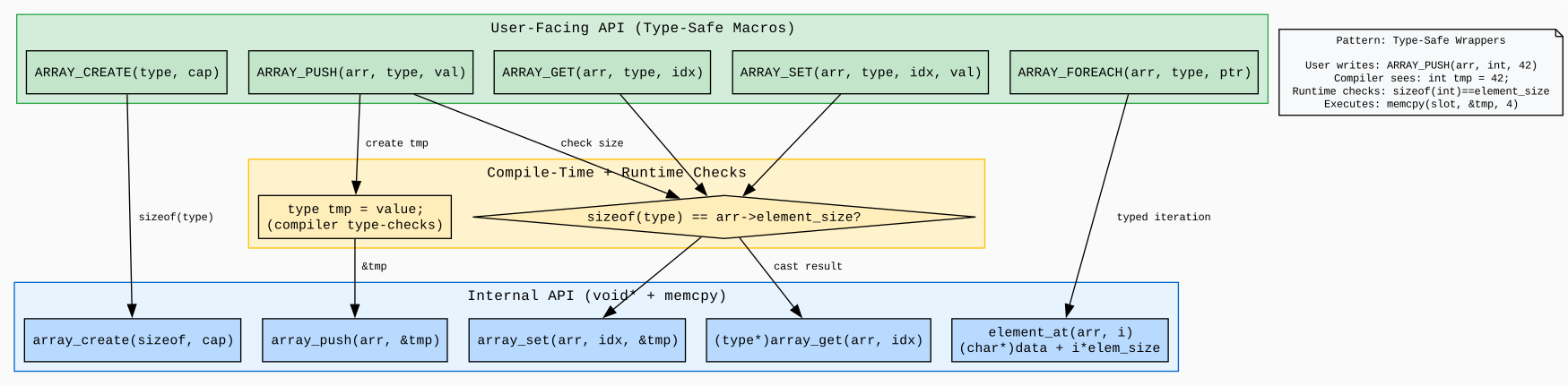
The Graphviz diagram shows the architecture from a different angle: the green layer (macros the user calls), the yellow layer (sizeof checks and typed temporaries), and the blue layer (the void* functions that actually manipulate memory). The arrows show how each macro delegates through the safety checks to the internal API.
Try This and Watch It Fail
Experiment 1: The Size Mismatch. Create an array with ARRAY_CREATE(int, 4). Push a value with ARRAY_PUSH(arr, double, 3.14). Instead of silently copying 4 of 8 bytes (like raw void* would), the macro detects sizeof(double)=8 != element_size=4 and refuses the push. Run the program and read the error message, it includes the file name, line number, and both sizes. The array is untouched.
Experiment 2: Same-Size Different Types. Create an array with ARRAY_CREATE(int, 4). Push with ARRAY_PUSH(arr, float, 3.14f). On most platforms, sizeof(int) == sizeof(float) == 4. The size check passes. The macro happily stores the float’s bit pattern as if it were an int. Read it back with ARRAY_GET(arr, int, 0), you’ll get 1078523331 (the IEEE 754 representation of 3.14f interpreted as an integer). The macros can’t catch this. This is the fundamental limitation of size-only checking.
Experiment 3: Side Effects. Call ARRAY_PUSH(arr, int, x++). The macro expands value into int _push_tmp = (x++);. The increment happens once, correctly. Now imagine a badly written macro that evaluated value twice, you’d get x++ evaluated twice, incrementing x by 2. This is why the temporary variable pattern matters: it evaluates the value expression exactly once.
Experiment 4: Preprocessor Output. Run gcc -E post_05.c | grep -A 20 "_push_tmp" to see the actual macro expansion. Compare it to the conceptual expansion shown in Demo 5. The real output is uglier (all on one line, no formatting), but structurally identical.
Concepts and Tradeoffs
What the Macros Can and Cannot Catch
The size check (sizeof(type) != arr->element_size) catches mismatches where the types have different sizes: int (4) vs double (8), char (1) vs int (4), a 20-byte struct vs a 12-byte struct. This covers the most dangerous cases, the ones where memcpy would copy the wrong number of bytes and corrupt adjacent memory.
What it cannot catch: types with identical sizes. int and float are both 4 bytes on most platforms. unsigned int and signed int are always the same size. A struct with two ints and a struct with one long are often 8 bytes each. For these cases, the size check passes, but the interpretation is wrong.
To detect same-size mismatches, you’d need either typeof() (a GCC/Clang extension, not standard C) or _Generic (standard C11). With typeof, you could compare the type of the value to the type used at array creation. With _Generic, you could dispatch to different handlers based on type. Both approaches add significant macro complexity and reduce portability. The size check is a pragmatic middle ground: it catches the most dangerous errors (different-size types) with minimal machinery.
GCC Extensions vs Strict C11
The macros in this post use only standard C11 features: sizeof, do/while(0), the comma operator, the ternary operator, stringification (#), and __FILE__/__LINE__. They compile with -std=c11 -pedantic on any conforming compiler.
If you’re willing to restrict to GCC and Clang, typeof() opens up stronger checks. For example:
| |
This gives a compile-time error if the type doesn’t match, but it only works on compilers that support typeof. For a library intended to be portable across MSVC, GCC, Clang, and embedded compilers, the size-only runtime check is the safer choice.
Macro Hygiene
Several details in the macro definitions are defensive measures:
Every argument is parenthesized in the expansion: (arr), (value), (index). Without parentheses, ARRAY_GET(arr, int, a + b) would expand index to a + b, which could misbehave if the expansion contains operators with different precedence.
The temporary variable uses a prefixed name (_push_tmp, _set_tmp, _fe_i) to reduce the chance of shadowing a user variable. In production code, you’d use a double-underscore prefix or concatenate with __LINE__ to generate unique names.
ARRAY_PUSH is a statement macro (do/while). ARRAY_GET is an expression macro (ternary). The distinction matters: you can’t write int *x = ARRAY_PUSH(...) because it doesn’t return a value, and you can’t put ARRAY_GET(...) on a line by itself without assigning the result (though the compiler will accept it with a warning about an unused value).
The Two-Layer Architecture
The pattern we’ve built is common enough to have a name: two-layer API. The internal layer (void* functions) is the engine, it handles all the memory management, growth, and byte copying. The external layer (macros) is the dashboard, it provides type safety, convenience, and diagnostics. The engine doesn’t know about types. The dashboard doesn’t know about memory.
This separation has a practical benefit beyond type safety: the internal layer is testable independently. You can write unit tests that call array_push directly with void*, verify byte layouts, and test edge cases (NULL arguments, overflow, allocation failure) without any macro involvement. The macros are a thin veneer, they add zero bytes to the stored data and zero branches to the hot path (the size check is constant-folded by any decent optimizer when the types match).
Knowledge Test
Write a macro ARRAY_GET(arr, type, index) that returns a typed pointer. What happens if the user passes the wrong type?
| |
If the user passes the wrong type, say ARRAY_GET(arr, double, 0) on an int array, sizeof(double) (8) differs from element_size (4). The ternary takes the error branch: fprintf prints the mismatch, and the comma operator returns (double*)NULL. The array data is never accessed with the wrong type. No corruption, no undefined behavior.
What it cannot catch: if the user passes a type with the same sizeof (like float instead of int), the check passes. The bytes are reinterpreted through the wrong type, producing a valid but meaningless value. For same-size safety, you’d need typeof() or _Generic.
What’s Next
We have a generic array with a type-safe API. Push, get, set, iterate, all without manual casts or sizeof calculations. The macros catch the most dangerous type mismatches and produce clear diagnostics when they fire.
But we’ve been ignoring failures. What happens when malloc returns NULL? When realloc fails halfway through a growth? Right now, the functions print to stderr and return -1 or NULL, and the caller… ignores the return value entirely. Every ARRAY_PUSH in our demos throws away the error code. In production code, that’s a crash waiting to happen.
In Post 6: “When Things Go Wrong: Error Handling Strategies in C”, we tackle allocation failure head-on. We’ll implement push and insert functions that never corrupt the array on OOM, if realloc fails, the array remains in its pre-operation state. We’ll compare three error propagation strategies (return codes, callbacks, and abort) and choose one. And we’ll add the discipline of checking every return value, because in C, ignoring errors isn’t optimism, it’s a bug.
The type-safe macros we built today will carry forward into Post 6. The error handling will be added to the internal void* layer, and the macros will surface the errors to the caller without losing type safety.