Post 10 of the Dynamic Arrays in C series · Full source code on GitHub
The Loop You Write a Hundred Times
Every program that uses an array eventually writes the same loop. Create an index variable. Check it against the size. Access the element. Increment. Repeat. For our dynamic array, that loop looks like this:
| |
Five lines, two function calls per iteration, and a cast. It works. It has worked since K&R. And it has three problems that compound as codebases grow.
The first problem is ceremony. Every traversal repeats the same boilerplate: declare i, compare against array_size, call array_get, cast the void* result. The cast is especially painful, it’s a type-unsafe operation that the compiler can’t verify, repeated at every access site. If you change the array’s element type from int to double, the compiler won’t warn you that your casts are now wrong. The bug shows up at runtime, or worse, never, because the wrong-sized read happens to produce plausible values.
The second problem is coupling. The loop body knows that the array uses zero-based indexing, that array_get returns void*, that size is checked by comparison. If you later replace the array with a different container, a linked list, a hash map, a ring buffer, every loop that traverses it must be rewritten. The traversal logic is fused to the data structure’s internal representation.
The third problem, and the one that actually causes bugs, is mutation during traversal. Consider removing all even numbers from an array by iterating forward and calling array_remove when you find one. When you remove element at index i, every element after it shifts left by one position. The element that was at index i+1 is now at index i. But your loop increments i to i+1, skipping the element that just shifted into position i. If two even numbers are adjacent, say 8 and 14, the loop removes 8, shifts 14 into 8’s position, increments past it, and 14 survives the removal pass. This is not a theoretical concern; it’s one of the most common bugs in C code that modifies collections during iteration.
Languages with iterators solve these problems by abstracting traversal into an object. C++ has begin()/end() with pointer-like operators. Rust has Iterator with next() returning Option<T>. Python has __iter__/__next__ with StopIteration. Java has Iterator<E> with hasNext()/next() and a ConcurrentModificationException for mutation during iteration.
C has none of these built-in. But C has structs, function pointers, and macros, and that’s enough to build a lightweight iterator that captures the same semantics. Our iterator won’t match C++’s generality or Rust’s zero-cost abstractions, but it will do three things that raw index loops cannot: encapsulate traversal state so the caller doesn’t manage indices, support filtered iteration through predicate callbacks (building on Post 7’s function pointer patterns), and detect when the array is modified during iteration so the caller gets a clear signal instead of a silent wrong answer.
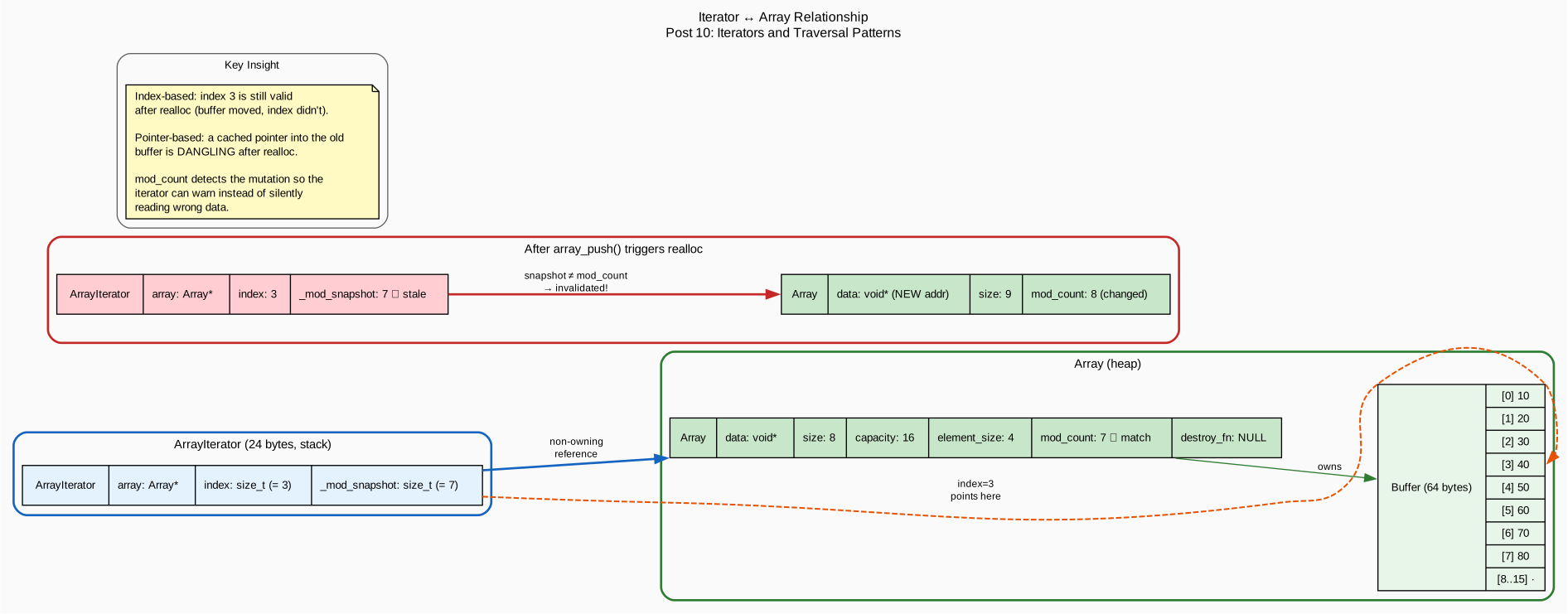
The key design decision is how the iterator references elements in the array. A pointer-based iterator, the approach C++ vectors use, caches a raw pointer into the buffer and advances it by element_size bytes each step. This is fast (one pointer addition per step, no multiplication), but it has a fatal flaw: if array_push triggers realloc, the buffer moves to a new address, and the cached pointer becomes a dangling pointer into freed memory. Dereferencing it is use-after-free, undefined behavior that can corrupt memory, crash, or silently produce wrong results. An index-based iterator stores an integer index instead. After realloc, index 3 is still index 3, the index doesn’t encode the buffer’s address, so it survives the move. The cost is one multiplication per access (index * element_size), which the CPU’s address generation unit handles in a single cycle. That’s the trade we make: one cycle per access in exchange for surviving realloc.
This post implements the index-based approach, adds a modification counter for invalidation detection, and shows the four patterns C programmers actually use to traverse and mutate arrays safely.
The Code
The full file compiles with zero warnings under gcc -Wall -Wextra -std=c11, runs five demonstrations (basic iterator traversal, index-vs-iterator comparison, filtered iteration with predicates, iterator invalidation, and safe removal patterns during iteration), and generates both ASCII visualization and a Graphviz DOT file.
The complete source, all five demos, the iterator API, the
ARRAY_FOREACHmacro, the invalidation detection mechanism, and the modification counter, is available on GitHub.
The Modification Counter
The first change is a new field in the Array struct:
| |
mod_count starts at zero and increments every time the array’s structure changes: array_push, array_insert, array_remove, array_swap_remove, and array_sort all increment it. array_set does not, it replaces an element in place without changing positions, so an iterator at index 5 still points at index 5 after a set on index 12.
This is the foundation the iterator builds on. Every mutating operation includes one line:
| |
The Iterator Struct
The iterator itself is a 24-byte value type (on 64-bit):
| |
Three fields, three responsibilities. array is a non-owning reference, the iterator doesn’t control the array’s lifetime. index is the current position. _mod_snapshot captures the array’s mod_count at the moment the iterator was created. When _mod_snapshot doesn’t match the array’s current mod_count, the iterator knows the array was modified and can refuse to operate.
The leading underscore on _mod_snapshot is a convention: it signals that the field is for internal bookkeeping, not for the caller to read or write. C doesn’t enforce this (there’s no private keyword), but the naming makes intent clear.
The Iterator API
The API follows the begin/valid/next pattern, C’s equivalent of C++’s begin()/end():
| |
The usage pattern reads like a while-loop:
| |
array_iter_valid does three checks in order: NULL safety, invalidation (is _mod_snapshot current?), and bounds (is the index within the array?). If any fails, the iteration stops. This means a push during iteration doesn’t crash, it silently ends the loop through the normal valid check, and the caller can inspect array_iter_invalidated(&it) to understand why.
Filtered Iteration
Building on Post 7’s ArrayPredicateFn, the iterator supports skip-to-next-match traversal:
| |
This advances the iterator until it finds an element satisfying the predicate or reaches the end. The pattern for iterating over all even numbers in an array becomes:
| |
The ARRAY_FOREACH Macro
For the common case, iterate every element, typed, a macro wraps the entire pattern:
| |
Usage:
| |
The double-for trick is a C idiom: the outer loop drives the iteration, the inner loop declares a typed pointer variable (val) that lives for exactly one iteration of the outer loop. The sizeof(type) == element_size check catches type mismatches at the start of the loop. The var_name = NULL in the inner loop’s increment ensures the inner body executes exactly once per outer iteration.
Concepts and Tradeoffs
Index-Based vs Pointer-Based: The Realloc Question
The central design decision, storing an index instead of a pointer, trades one CPU cycle per access for survival across realloc. Here’s why this matters.
A pointer-based iterator caches a direct pointer into the buffer: int *current = (int *)arr->data + 3. Advancing is cheap: current++ adds sizeof(int) bytes. No multiplication needed. But when array_push triggers realloc, the old buffer is freed and a new one is allocated at a potentially different address. The cached pointer still points to the old address. Dereferencing it is use-after-free.
C++ std::vector iterators are often implemented as raw pointers, and the standard explicitly states that push_back invalidates all iterators if it causes reallocation. The C++ programmer must either check capacity() before pushing or recreate all iterators afterward. This is a source of real-world bugs, the iterator compiles, runs, and produces correct results most of the time (when realloc returns the same address or the old memory hasn’t been overwritten yet), then corrupts memory in production under load.
Our index-based iterator sidesteps this entirely. Index 3 means “the element at offset 3 * element_size from wherever data currently points.” After realloc, data points to the new buffer, and the offset calculation produces the correct address. The index never encoded the old address, so it can’t become stale in that way.
The cost is one multiplication per array_iter_get call: index * element_size. On modern x86, this folds into the addressing mode of the load instruction, MOV eax, [rbx + rcx*4] computes base + index * 4 in a single cycle. It’s not free, but it’s close enough that you’ll never measure it outside a microbenchmark.
The Modification Counter: Detection, Not Prevention
mod_count is a compromise. The ideal solution would prevent mutation during iteration entirely, Rust does this through borrow checker rules that make it a compile-time error to mutate a collection while iterating it. C can’t express that constraint in the type system. The next best thing is runtime detection: let the caller mutate if they insist, but give the iterator a way to notice and react.
The counter is deliberately coarse. It increments on any structural change, even ones that don’t affect the current iterator. If you push an element at the end while iterating from the front, the new element is beyond your traversal range and wouldn’t affect you, but mod_count still increments, and the iterator reports invalidation. This is conservative by design: the cost of a false positive (stopping a traversal that would have been fine) is a minor inconvenience; the cost of a false negative (silently reading shifted data) is a data corruption bug.
Java’s ArrayList uses the same approach. Its modCount field increments on every structural modification, and its Iterator compares against it on every next() call, throwing ConcurrentModificationException on mismatch. The design is identical; only the syntax differs.
The Resync Escape Hatch
Sometimes you need to mutate during iteration and you know it’s safe. Removing the current element and not advancing (so the next element, which shifted into the current position, is examined on the next iteration) is safe, the indices after the removal point shifted, but you’re only looking at the current index. For this case, array_iter_resync(&it) updates the iterator’s snapshot to match the current mod_count, re-arming the invalidation check.
This is an explicit opt-in. The function’s name signals its intent (“I am deliberately acknowledging a mutation”), and the comment in the code warns against casual use. It’s the C equivalent of Rust’s unsafe block: the system provides a safety mechanism, and resync is how you tell the system “I’ve verified this is correct, trust me.”
The Four Traversal Patterns
C programmers use four patterns to traverse arrays, each appropriate in different contexts:
| Pattern | Use when | Mutation-safe? | Boilerplate |
|---|---|---|---|
| Raw index loop | Simple traversal, no mutation | No (caller’s responsibility) | High |
ArrayIterator | Need invalidation detection | Yes (detects, doesn’t prevent) | Medium |
ARRAY_FOREACH macro | Type-safe traversal, no mutation | Yes (stops on invalidation) | Low |
| Backward index loop | Removing elements during traversal | Yes (if done correctly) | High |
No single pattern dominates. Raw index loops are fine for quick, local code where you control both the loop and the array. Iterators pay for themselves in library code where the caller and the array owner are different people. ARRAY_FOREACH is syntactic sugar for the common read-only case. Backward loops are the classic solution for remove-during-iterate, and they work without any iterator infrastructure, you just need to understand why backward is safe and forward isn’t.
Try This and Watch It Break
Experiment 1: Two Iterators on the Same Array. Create two iterators with array_iter_begin, advance each independently, and verify they don’t interfere. Then call array_push and verify that both iterators report invalidation. The mod_count is on the array, not the iterator, so one mutation invalidates every outstanding iterator on that array simultaneously.
Experiment 2: Pointer-Based Iterator. Replace the iterator’s index field with a void *current pointer. Set current = arr->data in begin, advance with current = (char *)current + arr->element_size in next, and read with return current in get. Run the invalidation demo, push until realloc triggers. If AddressSanitizer is on (-fsanitize=address), you’ll see a heap-use-after-free. If it’s off, you’ll get garbage data or a crash, depending on whether the allocator reused the old buffer.
Experiment 3: Mutation Without Resync. In the filtered-iteration demo, try calling array_remove on a matching element without calling array_iter_resync. The next call to array_iter_valid returns 0, ending the loop early. Compare the results with and without resync to see exactly which elements get skipped.
Experiment 4: Stress the Modification Counter. Call array_push followed by array_remove (net zero size change). Does the iterator detect invalidation? Yes, mod_count incremented twice. Now do the reverse: array_remove then array_push. Same result. The counter doesn’t track what changed, only that something changed. Design a scenario where this conservatism causes a false positive that surprises you.
Knowledge Test
What happens to an iterator if you call
array_push()during iteration and it triggersrealloc?
Our index-based iterator: the iterator’s index is still numerically valid, index 3 is still index 3, because the index doesn’t encode the buffer’s address. But array_push incremented mod_count, so the iterator’s snapshot no longer matches. array_iter_valid() returns 0. array_iter_get() returns NULL. The iterator detects the invalidation and refuses to return data that might be stale.
A hypothetical pointer-based iterator: the cached pointer points into the old buffer. realloc may have freed that buffer. Dereferencing the pointer is use-after-free, undefined behavior. The iterator cannot detect this (there’s no modification counter to check). The result is silent data corruption, a crash, or a security vulnerability, depending on whether the allocator reused the old buffer and what data was written there.
The tradeoff:
| Approach | Survives realloc? | Detects mutation? | Per-access cost |
|---|---|---|---|
| Index + mod_count | Yes | Yes | 1 multiplication + 1 comparison |
| Raw pointer | No (UB!) | No | 0 |
| Raw index loop | Yes | No | 1 multiplication |
The index-plus-modification-counter approach costs one comparison per valid() call, completely negligible, and provides both realloc survival and mutation detection. The raw index loop survives realloc but can’t tell you when someone modified the array underneath you. The raw pointer is the fastest and the most dangerous.
What’s Next
We can now traverse the array with iterators that know when they’ve been invalidated, filter elements with predicate callbacks, and handle the tricky problem of removal during iteration using four distinct patterns, each with clear tradeoffs. The mod_count mechanism gives us Java-style fail-fast detection with zero overhead when no mutation occurs.
But the iterator’s access pattern, sequential, element-by-element, always forward or always backward, reveals something we’ve been taking for granted since Post 1: our array’s performance depends on access pattern. Sequential iteration is fast because the CPU prefetches contiguous memory. Random access is slower because each load may miss the cache. And the way we lay out struct fields, their sizes, their alignment, the padding the compiler inserts between them, determines how many elements fit in a single cache line.
In Post 11: “Memory Layout, Alignment, and Cache Performance”, we look inside the struct at the byte level. We examine why {char, int, char} wastes 6 bytes of padding, how _Alignas and alignof control placement, and why iterating an array of 12-byte structs is 3× faster than iterating an array of pointers to 12-byte structs, even though both contain the same data. The iterator we built today becomes the measurement tool: iterate a million elements, time it, change the layout, time it again.