Post 7 of the Dynamic Arrays in C series · Full source code on GitHub
Passing Behavior as Data
Our array can store any type, grow on demand, handle errors without corrupting state, and communicate failures through typed error codes. What it cannot do is anything interesting with the elements inside it. We can push, get, set, and insert, operations that treat the elements as opaque byte blobs. We can’t sort the array because sorting requires knowing how to compare two elements. We can’t search it because searching requires knowing what “matching” means. We can’t even destroy it properly when the elements own heap-allocated resources, because the array doesn’t know how to clean them up.
All of these problems have the same shape: the array needs to perform an operation that depends on the type of the stored elements, but type erasure means the array doesn’t know the type. The solution in C is function pointers, passing a function as an argument to another function, so the caller can inject type-specific behavior into a type-agnostic algorithm.
The concept is simple. A function pointer is a variable that stores the address of a function instead of the address of data. You can assign functions to it, pass it as an argument, store it in a struct, and call it through the pointer. When qsort needs to know whether element A comes before element B, it doesn’t hardcode the comparison, it calls a function pointer that the caller provided. The caller writes a 5-line comparator function that knows the type, and qsort uses it without ever knowing what type it’s sorting.
The syntax, however, is the worst in C. A function pointer declaration reads inside-out:
| |
This declares compare as a pointer to a function that takes two const void* arguments and returns int. The parentheses around (*compare) are mandatory, without them, int *compare(const void *, const void *) declares a function returning int*, not a pointer to a function returning int. The ambiguity is a parsing artifact from C’s declaration syntax, and every C programmer trips over it at least once.
The standard remedy is typedef:
| |
Now ArrayCompareFn is a type, and you can use it in function signatures like any other type: ArrayError array_sort(Array *arr, ArrayCompareFn compare). The ugliness is quarantined to one line.
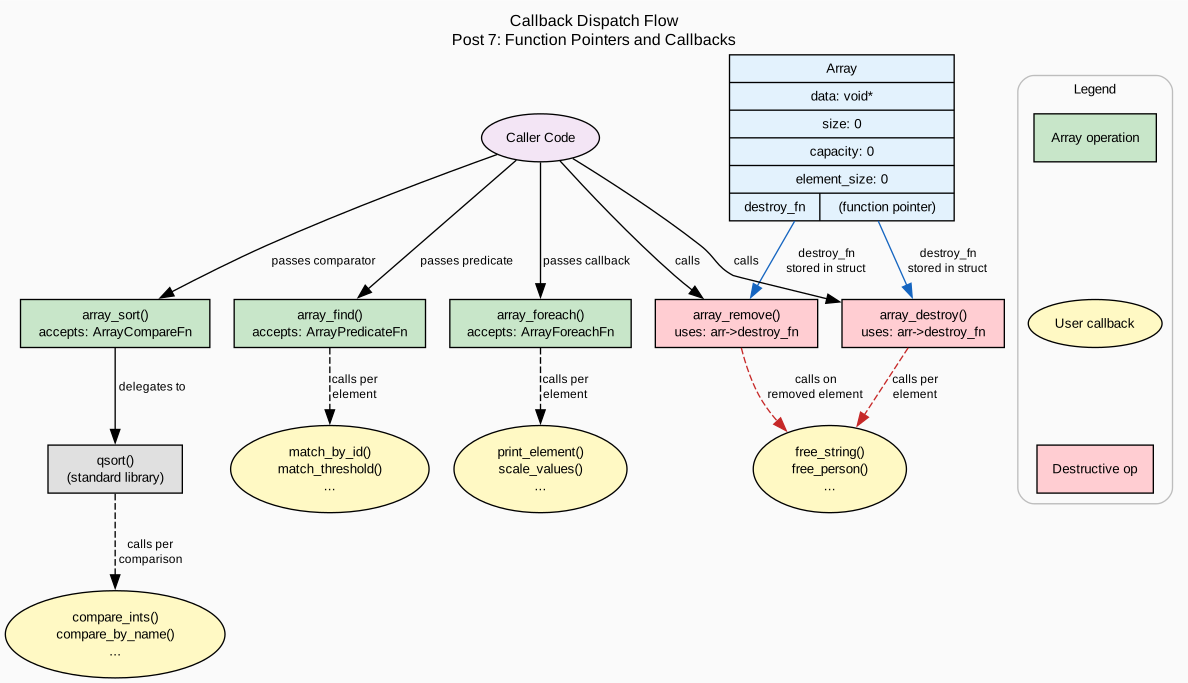
This post adds four callback-driven operations to the array: array_sort() delegates to qsort with a user-provided comparator. array_find() performs linear search with a predicate callback. array_foreach() iterates the array and calls a user function on each element, passing an optional context pointer that serves as C’s version of a closure. And the destroy_fn field, a function pointer stored in the struct itself, gives the array the ability to clean up elements that own heap-allocated memory.
The comparator design forces a decision that every C library faces: do we use qsort’s signature (standard, universally recognized, requires ugly double-dereference for pointer types) or a custom signature (cleaner, supports a context parameter, but incompatible with the standard library)? We use qsort’s signature, and this post explains exactly why, and exactly where it hurts.
The Code
The full file compiles with zero warnings under gcc -Wall -Wextra -std=c11, runs six demonstrations (sorting integers, sorting structs by different fields, searching with predicates, iterating with context, destructors for owned resources, and the qsort double-dereference subtlety), and generates both ASCII visualization and a Graphviz DOT file.
The complete source, all six demos, the callback-driven API, the destructor mechanism, and the DOT generator, is available on GitHub.
The Callback Types
We define four function pointer types, each typedef’d for readability:
| |
Each follows the same pattern: the callback receives a void* pointer to the element (or const void* for read-only operations), and optionally a context pointer. The context pointer is worth highlighting, it’s how C simulates closures. In JavaScript, you’d capture a variable from the enclosing scope. In C, you pack your variables into a struct and pass a pointer as context. It’s manual, but it works without heap allocation and is transparent to the debugger.
The Struct: One New Field
The only structural change from Post 6 is the destroy_fn field:
| |
This callback is stored in the struct, not passed as an argument, because it’s a property of the array, not of a single operation. The destructor applies to every destroy and remove operation for the lifetime of the array. You set it once after creation and forget about it:
| |
array_sort(): Delegating to qsort
The sort function is a thin wrapper around the standard library’s qsort():
| |
qsort already knows how to sort a contiguous buffer of elements, it just needs to know how many elements there are (arr->size), how big each one is (arr->element_size), where the buffer starts (arr->data), and how to compare two elements (compare). Our generic array stores exactly this information, so the delegation is natural.
array_find(): Linear Search with Predicate
| |
The predicate receives each element and a context (the search key or any other criteria), and returns non-zero on a match. The caller writes the predicate, so any search criterion is possible: match by ID, by name prefix, by threshold, by complex multi-field condition. The function returns a pointer to the first matching element, or NULL if none matches. The optional out_index parameter stores the index for callers who need it.
array_foreach(): Iteration with Context
| |
The callback receives a non-const pointer, it can modify elements in place. This is intentional: foreach is used for both read-only operations (summing scores, printing) and mutations (applying a curve, normalizing values). The context pointer carries any state the callback needs. For a sum operation, it’s a pointer to an accumulator. For a scaling operation, it’s a pointer to the scale factor. No globals required.
array_remove(): Destroy Before Shift
| |
The order matters: destroy then shift. If we shifted first, the element’s memory would be overwritten by the next element before the destructor could read it. If we destroyed after, the destructor would see the wrong element (the one that shifted into the slot). Destroy → shift → decrement is the only safe sequence.
The qsort Comparator: Why It’s Ugly and Why We Use It Anyway
The most confusing aspect of function pointers in C is the qsort comparator contract, specifically what happens with pointer types.
When the array stores value types (int, float, Person struct), each element sits directly in the buffer. qsort passes a pointer to each element’s location. If the buffer holds int values, each comparator argument is an int* (cast to const void*). One level of indirection:
| |
When the array stores pointer types (char*, Person*), each element in the buffer is itself a pointer. qsort passes a pointer to each element, a pointer to a pointer. If the buffer holds char* values, each argument is a char** (cast to const void*). Two levels of indirection:
| |
The rule is mechanical: qsort always gives you &buffer[i], which is a pointer to whatever the buffer stores. For type T, you get T*. For type T*, you get T**. The extra level of indirection is not a design flaw, it’s a consequence of qsort not knowing (and not needing to know) what the elements are.
Here’s the output from the demo that makes this visible:
╔════════════════════════════════════════════════════════╗
║  Unsorted strings                                      ║
╠════════════════════════════════════════════════════════╣
║  type: char*     element_size: 8     reallocs: 0       ║
║  size: 4         capacity: 4                           ║
║  destroy_fn: SET (elements will be cleaned up)         ║
╠════════════════════════════════════════════════════════╣
║  [ 0] +0     │ "delta"                                 ║
║  [ 1] +8     │ "alpha"                                 ║
║  [ 2] +16    │ "charlie"                               ║
║  [ 3] +24    │ "bravo"                                 ║
╠════════════════════════════════════════════════════════╣
║  32B used / 32B allocated = 100.0% utilization         ║
╚════════════════════════════════════════════════════════╝

  (after sort)

╔════════════════════════════════════════════════════════╗
║  Sorted strings (alphabetical)                         ║
╠════════════════════════════════════════════════════════╣
║  [ 0] +0     │ "alpha"                                 ║
║  [ 1] +8     │ "bravo"                                 ║
║  [ 2] +16    │ "charlie"                               ║
║  [ 3] +24    │ "delta"                                 ║
╠════════════════════════════════════════════════════════╣
║  32B used / 32B allocated = 100.0% utilization         ║
╚════════════════════════════════════════════════════════╝
Note element_size: 8, each element is a pointer (8 bytes on a 64-bit system), not a string. The strings live on the heap; the buffer holds addresses. The destroy_fn: SET line tells you the destructor is registered and will free those strings when the array is destroyed.
The Destructor: Solving the Ownership Problem
Post 4 raised a question we deferred: when the array stores pointers to heap-allocated data, who frees that data? The array owns its buffer, it allocated it, it reallocs it, it frees it on destroy. But the buffer holds copies of pointers, not the data those pointers reference. Destroying the array frees the buffer (and the pointer copies inside it), but the pointed-to memory, the strings, the structs, the whatever, remains allocated. Leaked.
The destructor callback solves this. You register a function that knows how to clean up one element:
| |
The callback receives a pointer to the element’s slot in the buffer. For char* elements, that’s a char**, the same double-dereference pattern as the comparator. You dereference once to get the char* (the heap address), then free it.
array_destroy calls this on every live element before freeing the buffer:
| |
The order is: destroy elements → free buffer → free struct. If we freed the buffer first, the destructor would be reading freed memory. If we freed the struct first, we’d lose the pointer to the buffer. This ordering is the only correct one, and it mirrors the construction order in reverse, a pattern you’ll see in every resource-managing destructor in C.
Concepts and Tradeoffs
qsort-Compatible vs Custom Comparator Signature
The standard qsort comparator takes two const void* arguments and returns int. It has no context parameter, if your comparison needs external state (a locale for string comparison, a field selector, a weight table), you must use a global variable or a thread-local.
A custom signature could be cleaner:
| |
The context parameter eliminates the need for globals. It also lets you write one comparator that sorts by any field, with the field specified at call time. Some modern libraries (glib’s g_qsort_with_data, BSD’s qsort_r) use this pattern.
We chose the standard signature for three reasons. First, every C programmer already knows it, the comparator from qsort works unchanged in array_sort. Second, comparators written for our library work with qsort, bsearch, and any other standard-library function that takes the same signature. Third, the double-dereference for pointer types, while ugly, is a concept you need to understand anyway, it appears everywhere in systems code, and avoiding it would leave a gap in the reader’s understanding.
The tradeoff is real: you lose the context parameter, which means comparators that need external state must use globals. For this series, where demos are single-threaded and comparators are simple, that’s acceptable. In a production library, qsort_r-style context would be worth the compatibility cost.
Destructor as Struct Field vs Function Argument
We store the destructor in the struct rather than passing it to array_destroy. This is a design choice with consequences.
Storing it in the struct means you set it once and it applies everywhere: array_destroy, array_remove, any future array_clear or array_pop. You can’t forget to pass it. The downside is that the destructor is global to the array, you can’t have different cleanup logic for different removal operations.
Passing it as an argument (array_destroy(arr, destroy_fn)) would be more flexible: you could use different destructors in different contexts. But it’s also more error-prone: forget to pass the destructor once and you have a leak. For a container that manages owned resources, the “set once, forget” model is safer.
The Subtraction Trap in Comparators
Many tutorials show integer comparators as return a - b. This works for small values but overflows for extreme ones: INT_MAX - (-1) wraps to a negative number, producing incorrect sort order. The safe pattern uses explicit comparison:
| |
This produces -1, 0, or 1 without any arithmetic that could overflow. The relational operators return 0 or 1, so the expression is always in range. It’s one more thing to remember, but it eliminates a class of bugs that only appear with extreme input values, the kind of bug that passes every test and fails in production.
Performance: The Callback Tax
Each callback-driven operation adds function call overhead per element. array_foreach calls the callback N times. array_sort calls the comparator O(N log N) times. array_find calls the predicate up to N times. On modern CPUs, a function call through a pointer costs roughly 2-5 nanoseconds more than an inlined comparison (the indirect call prevents branch prediction).
For most programs, this is negligible. For hot loops processing millions of elements per second, it matters. C++ solves this with templates (the comparator is inlined at compile time). C can partially solve it with macros (generate a type-specific sort function that inlines the comparison), but that trades code size and readability for performance. We stay with callbacks because the pedagogical clarity is worth more than the nanoseconds.
Try This and Watch It Break
Experiment 1: Remove the Destructor. Comment out the array_set_destroy_fn(arr, destroy_string) call in Demo 5. Compile with -fsanitize=leak and run. The sanitizer will report leaked strings, the array freed the pointer copies but not the strings they pointed to.
Experiment 2: Wrong Comparator Dereference. In compare_strings, change const char *const *sa = (const char *const *)a to const char *sa = (const char *)a (one level of indirection instead of two). Run the sort. The program will crash or produce garbage, you’re treating a pointer value as a string address.
Experiment 3: Mutable foreach. Write a foreach callback that doubles every integer in an array. Verify that array_get returns the doubled values afterwards. The callback receives a non-const pointer precisely to allow this.
Experiment 4: Stateful Predicate. Write a predicate for array_find that matches the Nth occurrence of a condition (e.g., “find the third person with score above 80”). Use the context pointer to carry a counter that the predicate increments on each match.
Knowledge Test
Write a comparator function that sorts Person structs by name. Why does qsort pass
void**notvoid*when the array stores pointer types?
The comparator for Person structs (value type) sorted by name:
| |
This works because Person is a value type, the array stores Person structs directly in the buffer. qsort passes a pointer to each Person’s location, so each argument is a Person*.
For pointer types (char*, Person*), qsort passes a pointer to the pointer stored in the buffer. The buffer holds char* values, and qsort gives you &buffer[i], a char**. You must dereference once to get the actual char* before comparing.
The rule is universal: qsort always passes the address of the element in the buffer. For type T, that’s T*. For type T*, that’s T**. The extra indirection isn’t a quirk, it’s the mechanical consequence of qsort not knowing (or needing to know) whether your elements are values or pointers.
What’s Next
We have an array that can sort itself, search itself, iterate with custom operations, and clean up owned resources. Function pointers gave us polymorphism, the ability to write one algorithm that works with any type, with the caller injecting the type-specific behavior at runtime.
But we’ve been trusting the caller to stay within bounds. array_get returns NULL for out-of-bounds access, but what about raw pointer arithmetic? What about debug builds vs release builds? What about documenting API contracts so the caller knows what they’re responsible for?
In Post 8: “Bounds Checking and Defensive APIs”, we add configurable bounds checking, assert in debug builds (catch bugs fast, zero overhead in release) vs runtime checks that return error codes (safe everywhere, small performance cost). We’ll define API contracts, add safe accessors, and show the #ifdef pattern that gives you both behaviors from one codebase. The callbacks from this post carry forward: the destructor, comparator, and foreach patterns remain part of the API.